
YOU DECIDED TO DONATE YOUR BODY TO SCIENCE?
So, You Want to Donate Your Body to Science? Free Is Doing a Lot of Work Here.
Your body may be a gift. Getting it where you want it to go may not be. And once a free body—or a free kidney—enters the medical system, “donation” gets a lot more interesting.
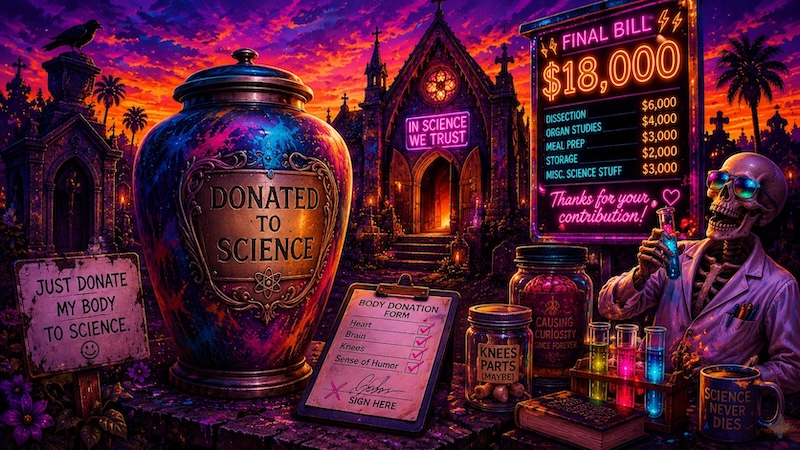
Look at the picture.
There’s a skeleton.
An urn.
A giant:
$18,000 FINAL BILL
And an invoice that looks like somebody dropped a dead body off at the dealership for an engine rebuild.
😂
The ridiculous line items are satire.
But the question behind the image isn’t.
IF I’M DONATING MY BODY FOR FREE… WHY COULD THIS END UP COSTING ANYBODY MONEY?
I’ve actually seen a real-world long-distance body-donation estimate in that neighborhood.
That doesn’t mean donating your body normally costs $18,000.
And it doesn’t mean a medical school is charging $18,000 to dissect you.
It means the word FREE can get complicated once somebody has to move a dead human being hundreds or thousands of miles, handle paperwork, meet a specific program’s rules and figure out what happens when science is finished with you.
And then there’s organ donation.
Because the same basic question shows up again:
THE GIFT IS FREE. IS EVERYTHING BUILT AROUND THE GIFT FREE?
Not even close.
LET’S START WITH A DEAD BODY 1,000 MILES FROM WHERE IT NEEDS TO GO
Suppose you’re living somewhere out West.
You have a favorite medical institution.
Maybe you’ve received great care there.
Maybe you believe in its research.
Maybe you simply decide:
“When I die, I want my body donated to someplace like the Mayo Clinic in Rochester, Minnesota.”
Sounds simple.
You die.
Science gets the body.
Everybody wins.
NOT SO FAST.
Mayo Clinic’s whole-body donation program is in Rochester, Minnesota. Mayo will consider registered donors from anywhere in the United States, but the body generally needs to be in Mayo’s care within 48 hours.
If you die outside Minnesota, Mayo says your family must work with a local funeral home for the initial transfer, paperwork, permits, death-certificate preparation and transportation coordination.
Mayo says there is no direct cost for donating the body itself and that it has limited funds available to reimburse some transportation costs.
But additional expenses can become the responsibility of the donor’s estate or family.
And Mayo specifically warns that the farther away the death occurs, the greater the transportation expense and the greater the possibility that the donation won’t happen at all.
Mayo Clinic: Costs Associated With Body Donation
THE BODY MAY BE FREE.
GETTING THE BODY THERE MAY NOT BE.
AND NO, YOU’RE NOT TAKING GRANDMA ON A ROAD TRIP
This is not:
WEEKEND AT BERNIE’S: ROCHESTER EDITION.
😂
You’re not putting sunglasses on Grandma, fastening her seat belt and telling the Minnesota Highway Patrol:
“Don’t worry, Officer. She’s just really tired.”
A dead human being isn’t a piece of luggage.
There are professionals involved.
Paperwork.
Transportation.
Permits.
Timing requirements.
State rules.
And depending upon where somebody dies and where they insisted upon going…
A LOT OF MILES.
So:
“Just donate me to science.”
isn’t really a plan.
It’s an idea.
THERE IS NO SUCH THING AS “THE” BODY DONATION PROGRAM
This may be one of the biggest things people miss.
Different institutions have different rules.
Mayo has its rules.
Mount Sinai has its rules.
Other medical schools have theirs.
- Who pays transportation?
- How far will they travel?
- What can disqualify you?
- How quickly must the body arrive?
- How long might they keep it?
- What happens afterward?
The answers aren’t universal.
“I’M DONATING MY BODY TO SCIENCE” IS NOT THE END OF THE CONVERSATION.
It’s the beginning.
WAIT. SCIENCE CAN STILL REJECT ME?
Yep.
Apparently rejection can follow you all the way to the grave.
😂
Mayo says being registered does not guarantee your body will ultimately be accepted.
Reasons can include certain infectious diseases, decomposition, autopsy, some physical or surgical conditions, failure to get the body to Mayo within 48 hours—and even the fact that donations simply aren’t needed at that particular time.
Mayo actually recommends having an alternate plan.
Mayo Clinic: Making a Whole-Body Donation
Think about that.
You filled out the paperwork.
Told everybody:
“I’m donating my body to science.”
You die.
And science essentially says:
“THANK YOU FOR YOUR INTEREST. WE’VE DECIDED TO GO IN ANOTHER DIRECTION.”
😂
Now your family needs Plan B.
Except you’re not around to help with Plan B.
That seems like something worth figuring out before you die.
SO WHAT ARE THEY ACTUALLY GOING TO DO WITH YOU?
This is where body donation becomes genuinely fascinating.
Whole-body donors can help teach anatomy, train medical professionals and support medical research and development.
Students can learn from you.
Doctors can train because of you.
Researchers may learn something because you existed.
That’s an extraordinary gift.
You can literally keep helping people after you’re dead.
YOU’RE DEAD AND YOU STILL HAVE A JOB.
😂
I respect that.
But I’m also a businessman.
And this is where I start looking at the transaction differently.
I’M A CAR SALESMAN. I SEE “FREE” DIFFERENTLY.
Let’s get away from dead people for a minute.
Suppose somebody gives a nonprofit a car.
Free.
Title signed.
Keys handed over.
The donor wants nothing for it.
Now somebody tows it.
Inspects it.
Repairs it.
Processes paperwork.
Advertises it.
And eventually that vehicle creates revenue.
Maybe every step is perfectly legitimate.
The tow truck shouldn’t have to work for free.
The mechanic shouldn’t have to work for free.
Employees shouldn’t have to work for free.
But don’t tell me the donated car had no economic value simply because the person who owned it gave it away.
THE CAR WAS FREE.
THE ECONOMIC ACTIVITY AROUND THE CAR WASN’T.
That’s how a car salesman sees it.
And frankly, that’s how I look at human donation too.
NOW REPLACE THE CAR WITH A KIDNEY
This is where things get uncomfortable.
A human being can donate a kidney.
The donor cannot legally sell it.
Federal law prohibits buying or selling human organs for transplantation.
OrganDonor.gov: Organ Donation FAQ
So the person who actually owns the kidney gives it away.
For nothing.
That gift may save somebody else’s life.
That’s incredibly generous.
But the kidney doesn’t suddenly enter a money-free universe.
OrganDonor.gov says the donor’s family does not pay the donation costs. Insurance or the people receiving the donated organ pay those costs.
It also tells transplant recipients directly that transplantation costs money before, during and after surgery, including things such as testing, organ removal, surgeons, hospital care, recovery and anti-rejection medicine.
OrganDonor.gov: The Transplant Process and Costs
THE KIDNEY IS DONATED.
THE SYSTEM AROUND THE KIDNEY ISN’T.
That’s not conspiracy theory.
That’s how the system works.
WHO ACTUALLY DONATED SOMETHING?
The donor donated the kidney.
Did the surgeon donate the surgery?
No.
Should the surgeon work for free?
Of course not.
Did the hospital donate the operating room?
No.
Did the laboratory donate all the testing?
No.
Did the people transporting the organ donate their services?
No.
Did the pharmaceutical company promise free anti-rejection medication?
No.
Did the insurance company suddenly become a charity?
😂
No.
Again, I’m not arguing that skilled medical people shouldn’t get paid.
They should.
My point is different.
THE PERSON CONTRIBUTING THE IRREPLACEABLE HUMAN ASSET IS THE PERSON WHO IS REQUIRED TO GIVE IT AWAY.
Everybody else can legitimately be compensated for the services performed around that donated asset.
And from where I sit, that’s worth thinking about.
BUT THEY’RE NONPROFITS!
Okay.
I think people hear the word nonprofit and mentally translate it into:
NO MONEY.
That’s not what nonprofit means.
Nonprofit institutions can receive donations, collect revenue, pay employees, build facilities and pay legitimate operating expenses.
The fact that an organization is nonprofit doesn’t mean money isn’t moving through it.
IRS Publication 557: Tax-Exempt Organizations
And there is clearly money moving through the transplant system.
CMS maintains cost-reporting data specifically for Organ Procurement Organizations.
CMS: Organ Procurement Organization Cost Reports
CMS also runs a current kidney-transplant model that uses financial incentives tied to transplant-hospital performance.
CMS: Increasing Organ Transplant Access Model
So putting the word nonprofit on an organization doesn’t make me stop asking financial questions.
THIS IS WHERE I PROBABLY SEE IT DIFFERENTLY THAN MOST PEOPLE
I see somebody doing something incredibly generous.
They give away a kidney.
Or their entire body.
They don’t ask to get paid.
They may save somebody’s life.
They may help train a future surgeon.
They may contribute to research that helps people they will never meet.
That’s the generous part.
THEN I SEE AN ENTIRE ECONOMIC SYSTEM FORM AROUND THAT FREE GIFT.
And as a salesman, I can’t unsee that.
If somebody hands me a valuable car for free and I build a paid system around processing that donated asset, I’m economically benefiting from somebody else’s generosity.
I may have legitimate expenses.
I may perform valuable work.
I may even be operating as a nonprofit.
But the donated asset still has economic value.
From my perspective, it’s fair to ask where legitimate cost recovery ends, where institutional self-interest begins and whether the donor has really been shown the entire economic picture.
I think parts of that system can become exploitative.
You may disagree.
That’s okay.
But I don’t think the donor should only get the Hallmark-card version of the story either.
THE FREE GIFT IS VALUABLE. THAT’S WHY THEY WANT IT.
A medical school doesn’t accept a human body because it has no value.
It has educational value.
Research value.
Training value.
A donated kidney may have the ultimate value:
SOMEBODY ELSE GETS TO KEEP LIVING.
Yet the donor isn’t selling that kidney.
The donor is giving it away.
Everything needed to procure, transport, transplant and support that kidney can still exist inside a very expensive medical system.
You can believe that arrangement is appropriate.
You can believe parts of it are exploitative.
You can believe both things at once.
BUT IT IS NOT A MONEY-FREE EVENT.
That’s the distinction I think gets lost inside the beautiful word:
DONATION.
AND THEN THERE’S ONE LITTLE DETAIL: WHAT COMES BACK IS ASHES
At least with the whole-body programs we’re talking about here.
You don’t donate your intact body to Mayo, let them finish their work and then have the same body shipped home so the family can put it in a casket.
Mayo’s final-disposition choices involve cremated or biocremated remains.
The remains can be returned to the family or funeral home, permanently interred in Mayo’s vault at Oakwood Cemetery in Rochester, or handled through another arrangement at the donor or family’s expense.
Mayo Clinic: Final Disposition
Mount Sinai says that when its study of a whole-body donor is complete—typically about 16 to 18 months after donation—it arranges cremation. The ashes can be returned to the family or interred at Brick Church Cemetery.
Mount Sinai: Body Donation Program
SO WITH THESE WHOLE-BODY PROGRAMS, YOU’RE NOT COMING HOME INTACT.
What comes back, if that’s what you choose, is cremated remains.
That’s worth knowing before somebody casually tells the family:
“Just donate me to science.”
ORGAN DONATION IS DIFFERENT
This distinction matters.
Donating your organs after death does not automatically mean you’re going to be cremated.
OrganDonor.gov says you can donate organs, eyes and tissues and still have an open-casket funeral.
Your family can still choose burial.
And organ donation can conflict with whole-body donation.
Mayo, for example, says someone is not eligible for its whole-body program after multiorgan or skin donation, although eye donation may still be compatible.
So this is another thing to decide while you’re alive:
DO I WANT MY TRANSPLANTABLE ORGANS TO HELP INDIVIDUAL RECIPIENTS, OR DO I WANT MY WHOLE BODY TO GO TO A PARTICULAR MEDICAL PROGRAM?
Depending upon the program and circumstances, you may not get to do both.
AND AFTER SCIENCE IS FINISHED WITH YOU… WHERE ARE YOU?
This may be my favorite Grave Freak question in the entire article.
Suppose you give away your body.
Medical students learn from you.
Doctors train because of you.
Research benefits from you.
Eventually the work ends.
You’re cremated.
Your ashes may come back.
They may go into an institutional memorial location.
Your family may scatter them.
Maybe they bury the urn.
Maybe nobody ever buys you an individual gravestone.
So after making one of the most generous gifts a person can make…
WHERE DOES SOMEBODY GO TO FIND YOU?
LESTER MOORE GOT A ROCK
I just created another Grave Freak Parking Spot about a guy named Lester Moore at Boothill Graveyard in Tombstone, Arizona.
I first saw his grave when I was about ten years old.
His famous marker says:
HERE LIES LESTER MOORE
FOUR SLUGS FROM A .44
NO LES
NO MORE
I remembered that guy for decades.
I went back years later with my wife and kids.
And now I’m writing about him again.
Lester got a tombstone.
A memorable one.
A whole-body donor might contribute far more to modern medicine than Lester ever did…
AND NEVER HAVE AN INDIVIDUAL STONE FOR SOME TEN-YEAR-OLD KID TO DISCOVER.
That’s not an argument against body donation.
It’s a question about memory.
YOU PLANNED WHAT HAPPENS TO YOUR BODY. DID YOU PLAN WHAT HAPPENS TO YOUR NAME?
Maybe you don’t care.
Fair enough.
Maybe your instructions are:
“Use whatever you can. Burn what’s left. I’m dead.”
😂
That’s one approach.
But maybe you do care.
Maybe you want a marker even if your body isn’t underneath it.
Maybe you want your ashes buried.
Maybe you want a family plot.
Maybe you want a memorial bench.
Maybe you want a page on the Internet.
Maybe you simply want your kids to know where to go.
Maybe you want one last line somewhere that says:
I WAS HERE.
That’s worth deciding while you’re still capable of deciding it.
Because once you’re dead, everybody else gets a vote.
You don’t.
THE INVOICE IS A JOKE. THE QUESTION ISN’T.
That’s what the image is really about.
The fake invoice is ridiculous.
The $18,000 question isn’t.
I know of a real long-distance body-donation plan where costs in that neighborhood became part of the discussion.
That doesn’t mean every program costs that.
Some programs cover much more.
Some have geographic limits.
Some put transportation costs on the family.
Some may reject the donation entirely.
So don’t just ask:
“Is body donation free?”
Ask:
“WHAT WILL MY PARTICULAR PLAN COST, WHO PAYS EACH PART, WHAT HAPPENS TO ME WHEN THEY’RE FINISHED, AND WHAT HAPPENS IF THE PLAN FALLS APART?”
That’s a much better question.
SO, YOU WANT TO DONATE YOUR BODY TO SCIENCE?
Great.
Maybe you should.
It can be an incredibly generous thing to do.
But don’t stop at:
“IT’S FREE.”
- Find the actual program.
- Read the agreement.
- Ask about transportation.
- Ask who pays.
- Ask what can disqualify you.
- Ask whether organ donation conflicts with whole-body donation.
- Ask how long they may keep the body.
- Ask what happens when the work is finished.
- Ask whether your remains come back.
- Ask what happens if the program rejects you.
And then ask one last question that has almost nothing to do with medicine:
WHEN THEY’RE FINISHED WITH MY BODY, WHAT DO I WANT LEFT BEHIND TO SAY I WAS EVER HERE?
Because eventually the doctors go home.
The research continues.
The transplant recipient goes on living.
The bills get paid.
Your body becomes ashes.
And what’s left is whatever story you arranged to leave behind.
THAT’S GRAVE FREAK.
Body-donation requirements, acceptance criteria, transportation rules and costs vary by program and can change. If you’re considering whole-body or organ donation, verify the current rules directly with the institution involved. This Parking Spot is commentary and general information, not medical, legal or financial advice.
⭐ WANT TO SHARE YOUR OWN ANALYSIS?
GraveFreak.com gives you a full‑page Parking Spot for $7 — no subscription, no renewal, no expiration.
Your page. Your voice. Your analysis.
Then add StoryDrive™ if you want guaranteed views delivered to your Parking Spot.