
THE CHURCH USED TO KEEP THE DEAD OUT BACK. NOW WE OUTSOURCE THEM.
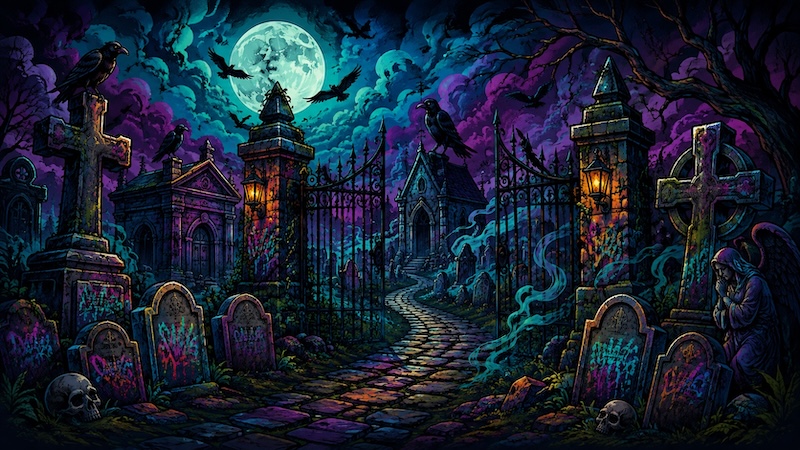
Christianity Preaches the Resurrection of the Dead.
So When Did the Body Become Somebody Else’s Problem?
A GraveFreak.com commentary about churchyards, cremation, resurrection, dead churches—and what may have been lost when Christians stopped walking past the dead on their way to worship.
There was a time when you didn’t have to drive across town to find the dead.
They were outside the church.
You walked through the churchyard.
You passed the headstones.
You saw the names.
You saw the dates.
You saw a relative placing flowers on a loved one’s grave.
You walked past generations of people who had sat inside that same church, heard the same Scriptures, buried their parents, raised their children, worried about tomorrow—
and eventually became the person beneath the stone.
Then you walked through the church door.
Think about that for a minute.
Before the preacher ever opened his Bible, the dead had already preached the first sermon.
“You are going to die.”
THE GRAVEYARD WASN’T JUST LANDSCAPING
Today we tend to use the words graveyard and cemetery almost interchangeably.
But historically, the old graveyard was often exactly what the word suggests:
A burial ground connected to the church.
The church and the dead occupied the same property.
The living worshipped inside.
The dead waited outside.
And if Christianity is actually true, that arrangement makes an enormous amount of sense.
Because Christianity isn’t ultimately selling better Mondays, nicer marriages, successful children, political victories or a more positive attitude.
At the center of Christianity is something considerably more radical:
A dead man walked out of a grave.
Jesus Christ was crucified and killed.
His body was placed in a tomb.
And Christianity claims that three days later He physically rose from the dead.
- Not metaphorically.
- Not as a fond memory.
- Not merely as a spirit floating somewhere.
He got up.
Christianity then extends that promise to everybody else.
The resurrection of the dead is not some strange little side doctrine buried in the back of the Bible.
It is the whole deal.
Paul essentially says that if the dead do not rise, Christianity collapses.
So here’s something I find fascinating:
WHY DID THE RELIGION BUILT AROUND RESURRECTION BECOME SO COMFORTABLE MAKING THE BODY DISAPPEAR?
NO, THIS ISN’T AN ARGUMENT THAT GOD CAN’T RESURRECT ASHES
Before somebody starts typing furiously, that isn’t my argument.
If God created man from the dust of the earth, I seriously doubt an urn presents Him with a technical problem.
People die at sea.
People burn in fires.
Bodies decay.
People disappear in war.
Thousands of years eventually reduce everybody to pretty much the same earthly ingredients.
The question isn’t whether God can resurrect somebody who was cremated.
Of course He can if the Christian claim about God is true.
I’m asking something different.
WHAT HAPPENED TO CHRISTIAN CULTURE WHEN CHRISTIANS REMOVED THE DEAD FROM THEIR FIELD OF VISION?
Because something changed.
THE BIBLE IS OVERWHELMINGLY A BURIAL CULTURE
Abraham buried Sarah.
Abraham was buried.
Isaac was buried.
Jacob was buried.
Joseph’s bones mattered enough to be carried out of Egypt.
Kings were buried.
Prophets were buried.
Lazarus was placed in a tomb.
Jesus was placed in a tomb.
The biblical record does contain unusual instances involving the burning of human remains, so I wouldn’t make the simplistic claim that a human body is never burned anywhere in Scripture.
In the case of Saul and his sons, however, their bodies were burned and their bones were then gathered and buried.
Even after the burning, the remains still mattered.
And God told Cain that Abel’s blood was crying to Him from the ground.
Wait. What?
Scripture repeatedly treats what happened to the dead as something more significant than simply disposing of biological material.
Burning the dead is certainly not presented as the ordinary burial practice of God’s people.
Burial is.
And Christianity reaches its climax with a burial site that suddenly becomes empty.
Am I missing something here because, I don’t know, that seems pretty important.
THEN SOMETHING STRANGE HAPPENED
Traditional Judaism still places tremendous importance on burial.
Islam also remains strongly burial-oriented.
Meanwhile, throughout much of modern Western Christianity, cremation has become completely ordinary.
Funeral home.
Service.
Crematorium.
Urn.
Affordable.
Maybe scatter the ashes somewhere meaningful.
Maybe put them on a mantle.
Maybe bury the urn.
Maybe somebody eventually inherits it and wonders what they’re supposed to do with Grandma.
And the church?
Frequently the church is basically done after the funeral.
Which strikes me as fascinating.
The institution preaching eternal life increasingly outsources the dead to somebody else.
We tell the family, “He’s with Jesus now.”
And then, culturally speaking, the church’s relationship with the physical person is largely finished.
But think about the contradiction.
Every Sunday Christians sit in churches reading words written by dead men.
- Moses is dead.
- David is dead.
- Paul is dead.
- Peter is dead.
The lives those men lived in their bodies apparently mattered enough that we’re still reading their words thousands of years later.
So why does the physical reality of death suddenly become somebody else’s department when one of us dies?
MAYBE THE DEAD WERE PART OF THE MARKETING
Many Christian churches today are dead.
I know.
I’ve been in them.
There’s a church on every corner in some towns and a handful of people sitting inside.
An enormous building.
A few people singing.
A few people listening.
A congregation that grows older every year while another generation drives past without giving the building much thought.
And maybe somewhere along the way the modern church accidentally threw away one of the greatest marketing tools Christianity ever had.
THE GRAVEYARD.
Think about what that old arrangement did.
You couldn’t walk onto the church property without confronting reality.
There was George.
1872–1941.
There was Mary.
1881–1953.
There was somebody’s child who lived four years.
Somebody who lived ninety.
- A veteran.
- A mother.
- A father.
- A preacher.
- A farmer.
Somebody who probably thought he had plenty of time.
Just like you.
- You didn’t need a theological degree.
- You didn’t need a PowerPoint presentation.
- You didn’t need dramatic music.
- You didn’t even need a preacher yet.
THE REALITY OF LIFE AND DEATH WAS STARING YOU SMACK DAB IN THE FACE BEFORE YOU EVER REACHED THE CHURCH DOOR.
NOW DRIVE UP TO THE MEGA CHURCH
Look at the modern arrangement.
You may find an enormous parking lot.
- LED screens.
- A bookstore.
- A children’s center.
- A coffee shop.
- Professional lighting.
- A sound system capable of rattling fillings.
- A worship band.
- A gymnasium.
- Maybe several thousand seats.
Everything necessary to create a modern religious experience and make you feel like God loves you.
What are you probably not going to find?
GRANDMA BURIED BEHIND THE SANCTUARY.
😂
And that’s strange when you really think about it.
Because the entire enterprise supposedly exists because Christians believe a dead man walked out of a tomb.
Yet we’ve become remarkably efficient at getting dead people off the property.
WE’RE STILL LOOKING FOR THE DEAD
Here’s another strange part of this.
Modern culture didn’t lose its fascination with death.
Not even close.
- People watch paranormal television shows.
- They go on ghost tours.
- They walk through old cemeteries looking for unusual gravestones.
- They visit famous graves.
- They investigate haunted buildings.
- They listen to podcasts about near-death experiences.
- They watch people wander through abandoned hospitals at 2:00 in the morning asking, “Is anybody here?”
😂
Apparently we’re still interested in the dead.
WE JUST DON’T EXPECT TO FIND THEM AT CHURCH ANYMORE.
Think about how bizarre that is.
Churches spend millions of dollars constructing buildings designed to attract people.
- Marketing.
- Signs.
- Lighting.
- Coffee.
- Children’s programs.
- Concert-quality sound systems.
- Social media.
- Advertising.
- Special events.
Meanwhile, there are people voluntarily paying money to walk through cemeteries at night because they’re fascinated by one of the central subjects Christianity claims to have an answer for:
WHAT HAPPENS WHEN YOU DIE?
Now imagine something completely backwards.
Imagine if some of those churches with multimillion-dollar building budgets were also known for taking care of the dead.
- Preserving old cemeteries.
- Restoring forgotten headstones.
- Researching the people buried there.
- Helping families locate graves.
- Recording cemetery histories.
- Hosting historical cemetery walks.
- Helping people preserve family stories.
- Teaching people what Christianity actually says about death and resurrection while standing twenty feet from somebody who already died.
Suddenly the cemetery isn’t dead property behind the building.
IT’S PART OF THE MINISTRY.
And now imagine one of those paranormal “seekers” showing up because he heard there was an old graveyard behind the church with fascinating history.
Maybe he came looking for a ghost.
Maybe instead he encounters a question:
If the person under this stone really will rise again someday, what does that mean for me?
Now you’ve got a conversation.
People are still searching for the dead.
The church just quit keeping them nearby.
Maybe the modern church didn’t need another marketing consultant.
MAYBE IT NEEDED TO STOP IGNORING THE PEOPLE BURIED OUT BACK.
THE DEAD USED TO PREACH BEFORE THE PREACHER DID
The old graveyard didn’t compete with Christianity.
It explained why Christianity mattered.
Before the preacher ever said a word, the graveyard told you:
Your life is temporary.
Then the church told you:
Death doesn’t have the final word.
That is one Hell of a combination—literally and figuratively.
Imagine having to walk past twenty generations of dead Christians before hearing somebody preach about resurrection.
Suddenly “eternal life” isn’t an abstract religious expression.
You’ve just walked past death in real time.
A GRAVESTONE IN HUDSON, WISCONSIN STOPPED ME DEAD IN MY TRACKS
I know exactly how powerful this can be because I’ve experienced it.
Years ago, I was walking through an old cemetery in Hudson, Wisconsin.
I passed gravestone after gravestone.
Names.
Dates.
People I had never met.
And then one stopped me dead in my tracks.
Someone who had once lived had left a simple message behind for whoever happened to walk past:
Remember me as you pass by,
As you are now, so once was I.
As I am now, so you shall be.
Prepare for death and follow me.
That’s it.
- No giant screen.
- No smoke machine.
- No worship band.
- No million-dollar building campaign.
Just a dead person talking to a living person through a piece of stone.
And it worked.
I remembered it.
In fact, I remembered it well enough that I quoted those words at the end of my book:
Wicked Darkness: Johnny’s Survival Guide to the End Times.
Why?
Because whoever put those words on that gravestone understood something about human beings.
WE ARE VERY GOOD AT PRETENDING WE AREN’T GOING TO DIE.
“AS YOU ARE NOW, SO ONCE WAS I”
Read it again.
As you are now, so once was I.
That person was alive.
- They got hungry.
- They got tired.
- They laughed.
- They got angry.
- They might have had a pet.
- They probably worried about things that ultimately didn’t matter.
- They probably had people they loved.
- They probably had unfinished plans.
- There was some ordinary day when that person woke up in the morning without knowing how many mornings remained.
Exactly like you did today.
Then:
As I am now, so you shall be.
There’s the sales pitch.
😂
Not exactly something modern marketing consultants would put on the church billboard.
But maybe they should.
Because that’s reality.
“PREPARE FOR DEATH AND FOLLOW ME”
That’s the line modern culture really doesn’t like.
Prepare for death.
We prepare for almost everything else.
- Retirement.
- Vacations.
- College.
- Taxes.
- Weddings.
- Babies.
- Car repairs.
- Insurance.
- Christmas.
- Our next phone.
- Our next house.
- Our next marathon.
- Our next promotion.
And yet the one appointment essentially everybody knows is coming is the one we spend enormous energy pretending doesn’t exist.
Death.
Christianity was never supposed to hide that fact.
It was supposed to answer it.
THE CHRISTIAN SALES PITCH IS DEATH
That probably sounds terrible.
But think about it.
- Strip away the church programs.
- Strip away the politics.
- Strip away denominational arguments.
- Strip away the coffee shop.
- Strip away the music.
- Strip away whether somebody worships on Saturday or Sunday.
- Strip away baptism arguments.
- Strip away disputes about which Bible translation is best.
What remains?
CHRIST DIED.
CHRIST WAS BURIED.
CHRIST ROSE.
AND THE DEAD WILL RISE.
That’s Christianity.
Everything eventually leads to a grave.
Christianity claims the grave isn’t the end.
- That’s the product.
- That’s the belief.
- That’s the pitch.
- That’s the promise.
- That’s the faith.
And somehow we’ve built a modern version of Christianity where people can attend church for twenty years without walking past a single grave to get there.
Maybe we’re missing something.
WE ARGUE ABOUT THE BODY UNTIL THE BODY IS DEAD
This is another contradiction I find fascinating.
Christians can become incredibly concerned about what somebody does while inhabiting his body.
- What he eats.
- What he reads.
- What he sees.
- What he drinks.
- Who he sleeps with.
- Whether he smokes.
- Whether he gets baptized.
- Whether he attends church.
- Whether he keeps the Sabbath.
- Whether he follows the Ten Commandments.
- Whether his body is modestly dressed.
- Whether he takes communion correctly.
- Whether he raises his hands during worship.
- Whether he kneels.
- Whether he stands.
- Whether he gets dunked or sprinkled.
We can build entire denominations around things people do with the body.
Then the heart stops.
And suddenly:
“Okay, what package did the funeral home offer?”
😂
I’m exaggerating for effect.
But not by much.
For a religion that proclaims the resurrection of the body, modern Christianity can sometimes act surprisingly detached from the body once the person dies.
MAYBE THE OLD CHURCHYARD UNDERSTOOD SOMETHING WE DON’T
Imagine Sunday morning 300 years ago.
You approach the church.
You pass your grandfather’s grave.
Then your grandmother’s.
You pass somebody who died before you were born.
A child.
A soldier.
The former pastor.
The woman who once sat three pews ahead of your family.
You know where your parents will probably be buried.
You may know where you will someday be buried.
Then you walk inside and hear:
“I am the resurrection, and the life…”
That verse hits differently when there are corpses twenty yards away.
Suddenly resurrection isn’t theology floating around in the clouds.
It’s about those people outside.
And eventually it’s about you.
SOME CHURCHES MAY HAVE LOST MORE THAN THEIR CONGREGATIONS
Maybe some of today’s dead churches didn’t just lose young people.
Maybe they didn’t just lose cultural influence.
Maybe they didn’t just lose good preaching.
Maybe they didn’t just lose relevance.
MAYBE THEY LOST THE DEAD.
They removed the physical reminder of mortality from the property.
Death became something handled elsewhere.
- The funeral director takes the body.
- The cemetery takes the remains.
- The crematory takes the ashes.
- The church returns to the living.
And Sunday morning rolls around again.
But something is missing.
The people outside aren’t there anymore whispering:
You’re next.
THAT ISN’T MORBID
I don’t think graveyards are depressing.
I think they’re honest.
Every headstone represents somebody who received exactly the same allotment we’re receiving right now:
Time.
Some got more.
Some got less.
Everybody eventually ran out.
A graveyard doesn’t need an algorithm to get your attention.
- It doesn’t care whether you’re rich.
- It doesn’t care whether you’re famous.
- It doesn’t care who you voted for.
- It doesn’t care how many followers you have.
- It doesn’t care whether you think you’re important.
The graveyard has seen important people before.
They’re still dead.
AND THAT MAY BE WHY GRAVEFREAK.COM EXISTS
Graves aren’t really about dead people.
They’re about living people confronting what death means.
- Memory.
- Family.
- History.
- Faith.
- Money.
- Burial.
- Insurance.
- Mystery.
- Regret.
- Legacy.
- Eternity.
And sometimes one odd gravestone in Wisconsin saying something that follows a stranger around for years.
That’s why the grave is such a fascinating place to start a conversation.
The person underneath it may be silent.
THE GRAVE ISN’T.
MAYBE THE OLD GRAVEYARD WAS PREACHING THE ENTIRE TIME
Maybe having to walk past the dead before worshipping among the living wasn’t depressing.
Maybe that was exactly the point.
The graves said:
YOU’RE NEXT.
The church said:
DEATH DOESN’T GET THE FINAL WORD.
Put those two messages together and Christianity becomes considerably harder to treat like another Sunday morning activity.
Because eventually the sermon stops.
- The music stops.
- The lights go out.
- The building closes.
And every person who attended eventually joins the people Christianity claims will someday hear the most important call of all:
GET UP.
Maybe some of today’s dead churches didn’t just lose people.
MAYBE THEY LOST THE DEAD.
WANT TO GO DEEPER INTO THE DARKNESS?
This commentary touches one small piece of a much larger question:
What does this life mean if death isn’t actually the end of the story?
I explore that question—and where I believe Scripture says this world is ultimately headed—in my book:
Wicked Darkness: Johnny’s Survival Guide to the End Times
Visit WickedDarkness.com to buy the book or read more of my articles about the spiritual implications of this life, death, prophecy, eternity and what may be coming next.
And stay tuned here at GraveFreak.com.
I’ll be creating more commentary like this about graves, death, faith, eternity, strange history and the things sitting right in front of us that most people walk past without ever stopping to think about.